澄彩 DAPPER PACK

Structural reference

Every box is a flat sheet that has been told what to do.

This page is the reference we work from: what each structure is for, how the drawing is laid out, and the trade terms that appear on a dieline. Nothing here is a client project — these are our own structural drawings, published so you can judge the work before you send anything.

Judge us on the dieline, the sample and a live walk of the workshop.
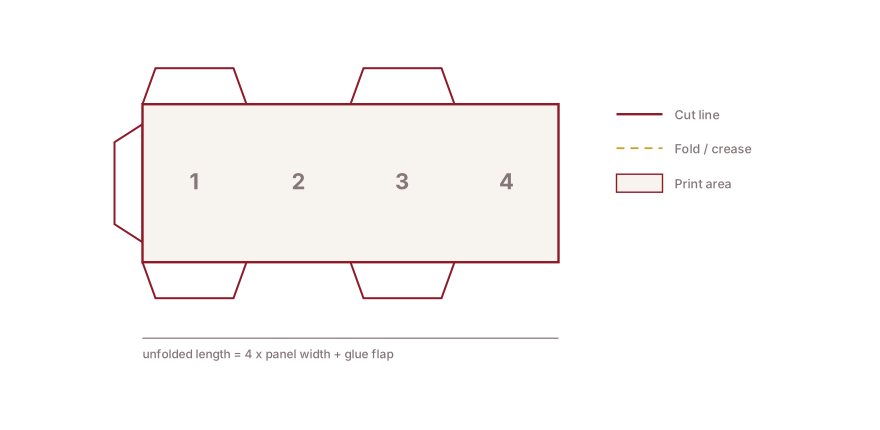
Line drawing of a flat carton blank showing the die-cut outline, fold creases, glue flap and a die-cut window.
A blank is read as a drawing, not as a picture.

Reading the drawing

Four line types carry the whole specification

A dieline is read by convention. Once you know these four, you can check any drawing we send — including whether the grain runs the way the box needs it to.

Cut line
The outline the die cuts. Solid on every drawing; anything outside it is waste.
Crease line
Where the board folds. Shown dashed. Its position fixes the internal dimensions — move a crease by a millimetre and the box either grips the product or rattles.
Grain direction
The direction the board fibres run, marked on the sheet. Creases should run with the grain; a box folded across it cracks at the fold and bows on the panel.
Glue flap
The narrow panel that becomes the seam. Its width depends on board thickness, and it is the first thing to fail if it is drawn too thin.

How to read a dieline we send you →

Structures

What we draw, and what each one is for

Three families cover most briefs. The drawing below each one is ours — an illustration of the structure, not a photograph of a delivered job.

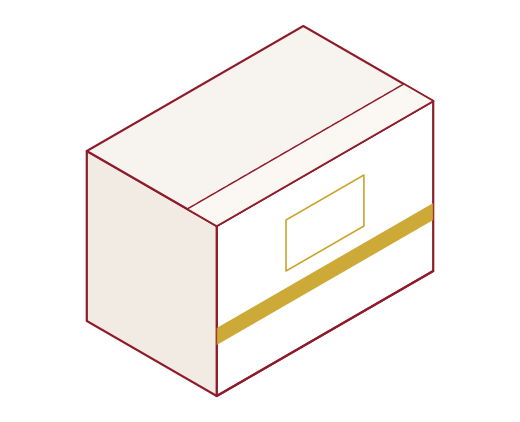
01 Line drawing of a tuck-end folding carton with a gold band and a die-cut window.

Folding cartons

One piece of printed paperboard, supplied flat and glued at the seam, erected by hand or on a packing line. The workhorse for retail shelf and e-commerce.
  • straight tuck
  • reverse tuck
  • crash-lock
  • auto-lock bottom
  • die-cut window
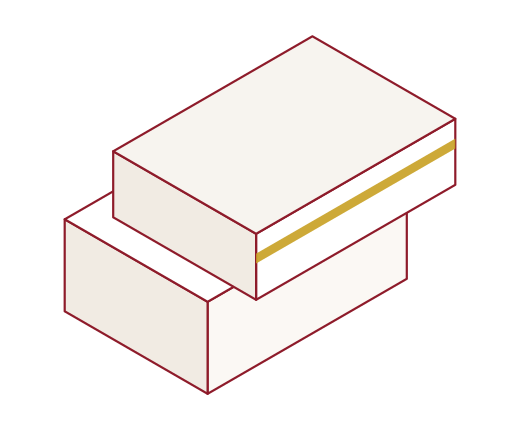
02 Line drawing of a rigid set-up box with a separate lid, lifted slightly and offset.

Rigid & gift boxes

A greyboard body wrapped in printed paper, made up rather than folded from one sheet. Stiffer, heavier, and the structure that carries a gift set.
  • lid and base
  • neck & shoulder
  • book-style
  • drawer / slipcase
  • magnet closure
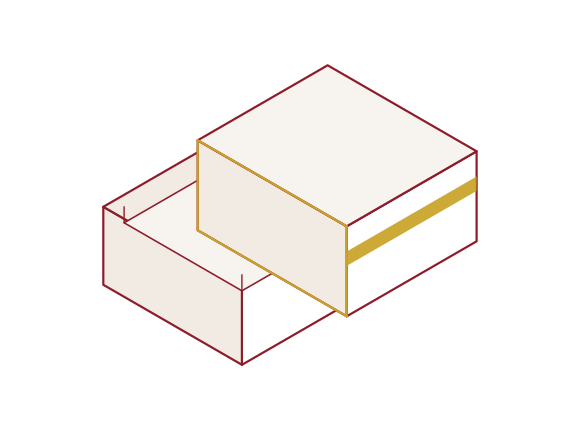
03 Line drawing of a two-piece carton with a printed sleeve sliding over a plain tray.

Trays, sleeves & inserts

The parts that hold the product still: a die-cut tray, a sleeve that carries the print, or a fitment cut to the shape of what goes inside.

  • tray & sleeve
  • fitment
  • E-flute insert
  • card platform
  • two-piece carton

Materials and finishing

The vocabulary a buyer uses on the phone

These are the terms we use in a quote, in the same words. If a supplier answers these loosely, the sample will show it.

Greyboard
The rigid core of a set-up box, measured in millimetres of thickness and quoted by grammage. The wrap is what you see; the greyboard is what you feel.
Wrap
The printed paper laminated over greyboard. Wrap direction decides which way the print runs across the lid, and where the turn-in lands on the inside.
Crease
A pressed fold line, as distinct from a cut. Creasing — rather than scoring lightly — is what stops the printed surface cracking along the fold.
Fitment
The insert that locates the product. Cut from card or E-flute to the outline of the item, or built as a platform with wells.
Bleed
Print that runs past the cut line so no white edge appears after trimming. We set the bleed on the drawing; your artwork needs to cover it.
Spot colour
A single mixed ink printed as its own plate, matched to a reference you supply, instead of built from process inks.

Next

Send a drawing, or ask us to make one

If you already have a dieline, we will quote from it and tell you if anything on it will cause trouble. If you do not, send the product dimensions and we will draw the structure — that costs you nothing.